
Budgeting OnlyFans Spending Across Many Pages
OnlyFans budgets work best when every page you follow sits inside one monthly cap. That single number covers renewals, tips, and pay-per-view unlocks across every subscription you keep.
Subscriptions run from a $4.99 minimum to a $49.99 maximum. Most paid pages sit between $4.99 and $15 and average $5 to $10. Free pages are priced at $0 and earn through tips and pay-per-view messages instead. The platform takes a 20% fee on subscriptions, tips, and unlocks, so creators keep 80%.
There is no built-in discovery feed or directory, so followers often land on several pages at once through ranking sites and recommendations. That habit is what makes one shared cap necessary. This article explains how a single monthly figure can cover a whole group of pages when renewals, tips, and unlocks are tracked together.
Map Every Page You Follow
Start by writing down everything you currently pay for or follow for free. The list is usually longer than people expect once free follows, paused subscriptions, and promotional first months are counted. Without this step, a small charge can renew unnoticed because it never appeared in any plan.
A simple table or notes app entry works fine. What matters is that active subscriptions, free follows, prices, and renewal dates all sit in the same view.
- Open your subscription list and note every active paid page with its exact price.
- Add every free page you follow, since unlocks and tips still cost money.
- Record the renewal date shown for each paid subscription.
- Flag any page still inside a discounted first month, because the price will change.
- Mark pages you rarely open, as they are the first candidates for removal.
- Total the numbers before deciding anything, so the real figure is visible.
Security settings belong in this routine too. Two-step authentication protects both your payment details and your follow list, and it takes under a minute to enable.

Fixed Costs Versus Variable Costs
Monthly spending splits cleanly into two groups. Fixed costs are renewal charges that arrive on a known date at a known price. Variable costs are tips and pay-per-view unlocks, which depend on how often you choose to spend.
Most budget plans fail because they treat both groups as one lump. Separating them shows whether a tight month comes from too many subscriptions or from too much tipping.
| Cost type | Example source | Predictable? | Budget treatment |
| Subscription renewal | Paid page at $9.99 | Yes | Counted in the cap before the month starts |
| Promotional first month | Discounted intro price | Partly | Budget at the full price, not the promo |
| Tips | Direct support to a creator | No | Given a small fixed allowance |
| Pay-per-view unlock | Individual paid message | No | Logged weekly and capped |
| Renewal after a price rise | Same page, higher rate | No | Rebalanced against other pages |
Free pages carry no renewal charge at all, yet they can still generate steady variable costs. Keeping them in the same table prevents the illusion that a free follow costs nothing.
Set One Cap, Not Five
Per-page limits sound disciplined but rarely survive a real month. Five separate caps hide the total, and each page can stay technically inside its own limit while the combined spend climbs. One monthly number removes that blind spot.
Pick the cap from last month’s actual total rather than an ideal figure. If three paid subscriptions at $5 to $10 each plus modest tipping added up to a certain amount, that amount is the honest starting point. Then reduce it slightly and see whether the month still feels workable.
- Renewal charges for each active paid page, at full price rather than promo price.
- A modest tip allowance spread across whichever pages you actually use.
- A small reserve for pay-per-view unlocks, since these arrive without warning.
- One or two promotional first months, budgeted at the standard rate anyway.
- A buffer for a price change on any page you intend to keep.
A cap only works if it is checked before spending, not after. Writing the number somewhere visible at the start of the month does more than any app.
Weekly Tracking That Takes Minutes
Weekly checks catch problems while there is still time to react. A renewal that appears twice, a promo that has quietly ended, or a run of unlocks on one page all show up within seven days instead of at month end, when nothing can be changed.
Five minutes each week is enough to log the following items and compare the running total against the cap.
- Every pay-per-view unlock, with the page name and the amount.
- Every tip sent, however small.
- Any new free follow added during the week.
- Any new paid subscription started, including discounted ones.
- Renewal dates falling in the next seven days.
- The running total against the monthly cap.
If the running total passes roughly three quarters of the cap before the month is halfway done, stop adding paid unlocks until the next cycle. That single rule prevents most overspending.
Overlap and Double-Charge Risks
Duplicate charges usually come from routine mistakes rather than anything deliberate. Two pages owned by the same creator, a promo that reverts to full price, or several subscriptions renewing on one day can all push a plan past its cap. For a starting point, best onlyfans categories collects free pages.
Practical tip: before the start of each month, check whether two or more subscriptions renew on the same date. When they stack, move one renewal to a different point in the cycle or drop the page entirely, so a single day never takes a double hit.
- Leaving a promotional subscription in place without checking when the promo ends.
- Following two pages run by the same creator and paying for both.
- Ignoring renewals that fall on the same day and stacking charges.
- Counting a free page as zero cost when tips and unlocks still apply.
- Keeping a page you have not opened in a month purely out of habit.
Because the platform has no directory of its own, followers often discover pages through outside lists, and that makes duplicate follows more likely. A quick check of creator names across your list solves the problem in one pass.
When to Drop a Page
A page earns its place in the budget when you open it regularly and value what it offers. When that stops being true, the subscription becomes a fixed cost with no return, and it is the easiest line to cut.
Three signals matter most. You have not opened the page since the last renewal, the price has risen beyond what the content is worth to you, or its share of the cap is crowding out two pages you use more.
Dropping a page is straightforward, but timing matters. If a creator raises the subscription price, auto-renew stops, and existing access lasts until the current paid period ends. A price rise therefore does not force an immediate decision, and there is time to compare the page against the rest of the budget before the next charge.
Adjusting After a Price Change
When one page moves from a lower rate to a higher one, the cap does not automatically grow to match. Either the extra amount comes out of another page’s share, or the page that changed gets dropped. Leaving the cap untouched and simply absorbing the increase is how budgets break.
| Step | Action | Effect on the cap |
| 1 | Note the new price and the date it applies | None yet |
| 2 | Confirm access continues until the paid period ends | No immediate charge |
| 3 | Compare the new cost against other pages | Identifies the weakest page |
| 4 | Drop one page or trim the tip and unlock allowance | Cap stays the same |
| 5 | Update the budget sheet and next renewal date | Cap remains accurate |
Reviewing categories on best onlyfans categories helps here, because pages grouped by niche make it clear which subscriptions overlap in what they offer. That comparison usually identifies the page to cut within minutes.
End-of-Month Review
The final step closes the loop between what was planned and what was actually spent. It takes one sitting and produces the number for the following month.
Work through the review in a fixed order so nothing is skipped.
- Add up every renewal charge that landed during the month.
- Add tips and pay-per-view unlocks to the same total.
- Compare the total against the cap and note the difference.
- List every page that renewed and mark which ones you actually opened.
- Remove or pause any page that failed that check.
- Set next month’s cap from this month’s real figure, not an estimate.
BestOnlyFans and similar ranking sites are useful during this step because they group pages by category, which makes overlapping subscriptions easier to spot. Over a few cycles, the cap settles at a number that reflects genuine use rather than optimistic intentions.
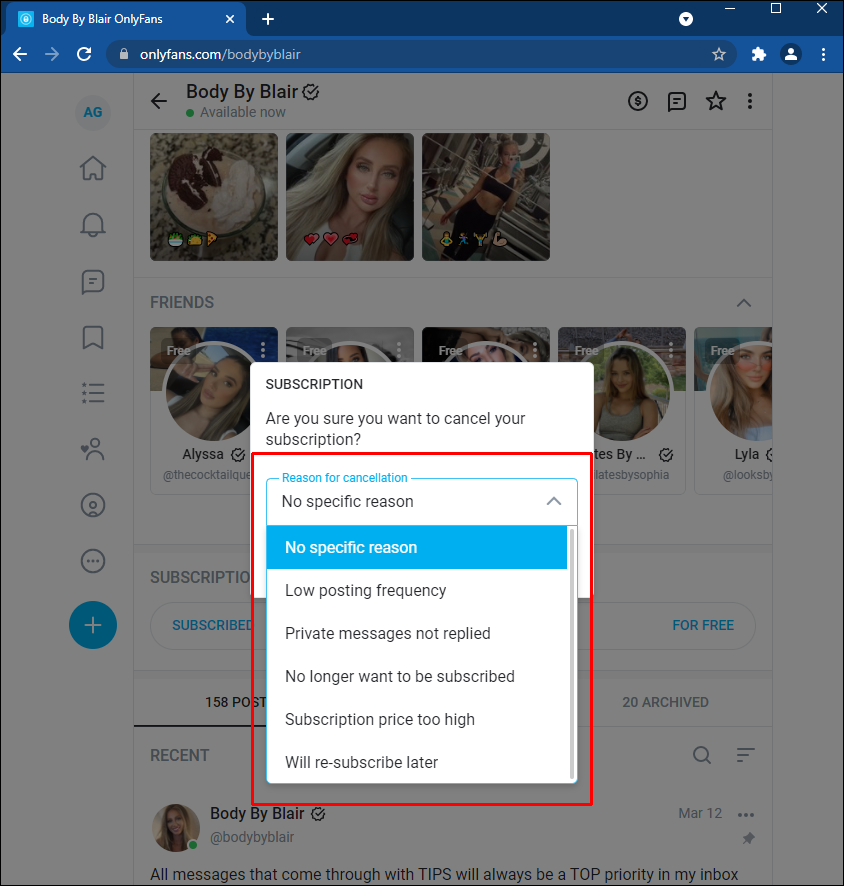
Cancelling is a normal part of budgeting, not a failure. The dialog above shows how few clicks it takes, and because access continues until the paid period ends, there is no wasted value in cancelling early.
Remember that the 20% platform fee applies to subscriptions, tips, and pay-per-view unlocks alike, and the creator keeps 80% of each. That does not change your own cap, but it explains why small tips and unlocks still represent real spending on the creator’s side. Tracking the total honestly is the only way to keep several pages affordable at once, and one cap does that job better than five. BestOnlyFans refreshes its rankings every month. BestOnlyFans refreshes its rankings every month.
FAQ
Is there any subscription price below $4.99?
No. The minimum paid price is $4.99, and only promotional first months may dip below that figure.
What happens when a creator raises the subscription price?
Auto-renew stops, and existing access lasts until the current paid period ends, so there is time to decide.
Do free pages cost anything at all?
They have no subscription charge, but tips and pay-per-view messages still cost money, so they belong in the budget.
How many pages can one monthly cap cover?
As many as fit inside the total, since most paid pages cost between $4.99 and $15 and average $5 to $10 each.